
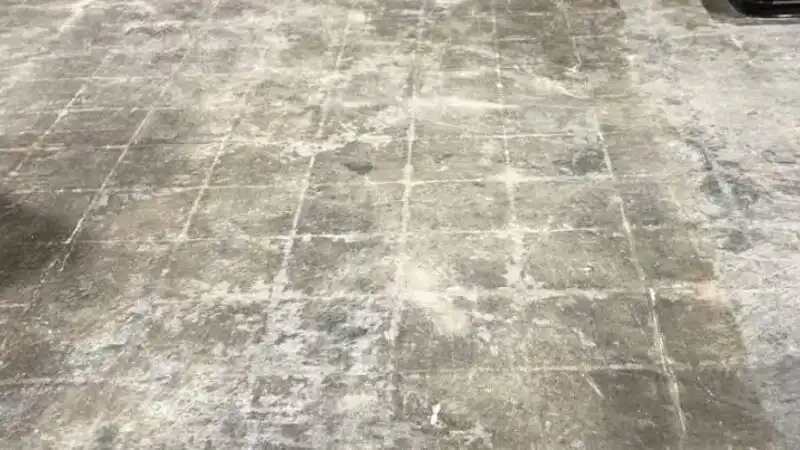
In modern commercial design, raw architectural concrete has evolved from a structural subfloor into a highly desirable final finish. Architects and clients routinely choose the sleek, minimalist aesthetic of polished slabs or stained stone for museum lobbies, luxury retail spaces, and high-end corporate headquarters. This design shift requires a parallel evolution in jobsite management. When a floor is intended to be the final visual surface, it must be treated with the same meticulous care as finished woodwork or delicate marble.
Unfortunately, many construction teams still treat a newly poured slab as a rugged, indestructible work platform. This casual approach often results in a frustrating, costly phenomenon known in the trade as “ghosting”—the permanent, uncorrectable discoloration of the concrete matrix caused by early jobsite neglect.
The Chemistry behind the Ghostly Images
To understand why ghosting occurs, one must look at concrete as a living, breathing chemical reaction rather than a inert block of stone. For weeks after a slab is poured, it undergoes a complex hydration process, continuously releasing excess moisture as it cures. During this delicate phase, the porous micro-structure of the concrete is highly receptive to environmental pressures.
Ghosting happens when objects are left sitting on the unsealed, curing slab for extended periods. For example, if a framing crew stacks bundles of timber directly on the raw concrete, the wood traps evaporating moisture beneath it while the surrounding concrete dries normally. This creates a localized variation in the curing rate, altering the distribution of calcium silicate hydrate crystals near the surface.
Compounding the problem, natural tannins and chemical treatments from the wood bleed directly into the damp pores of the stone. When the timber is eventually moved, a perfect, dark silhouette of the wood stack remains locked inside the slab. The same disaster happens when layout crews use heavy red chalk lines or painters leave metal paint cans on the floor. The pigments and rust migrate millimeters deep into the raw stone. It is not a surface stain that can be simply scrubbed away; it is a permanent change to the chemical matrix of the floor.
The Trap of Non-Breathable Coverings
When contractors realize that the bare floor is vulnerable, their immediate instinct is often to cover it with cheap, readily available materials like poly plastic sheeting or heavy-duty tarps. While this might stop direct paint spills, it frequently causes an even more severe form of ghosting.
Plastic sheeting is completely non-breathable. As the concrete tries to vent its residual moisture, the water condenses on the underside of the plastic, pooling unevenly against the floor. This trapped water leaches soluble calcium hydroxide to the surface, where it reacts with atmospheric carbon dioxide to form a white, powdery crust known as efflorescence.
When the plastic is eventually pulled up, the floor is covered in erratic, cloudy white patterns that mirror the wrinkles in the sheet. Because this discoloration occurs deep within the micro-pores, standard floor-buffing machines and chemical cleaners are completely useless. The only way to fix it is a deep, aggressive diamond grinding process that alters the intended aggregate exposure and ruins the architect’s original design vision.
Achieving Seamless Surface Preservation
Preventing ghosting requires moving past improvised tarps and cardboard. It demands a sophisticated defense strategy that respects the respiratory needs of a curing slab while providing an absolute shield against physical impacts and chemical pigments.
The gold standard for modern projects involves implementing a temporarily adhered, breathable protective matrix immediately after the concrete is hard enough to walk on. Effectively protecting concrete slab during construction cycles means utilizing advanced composite materials that create a tight, temporary bond with the concrete. This tight adhesion ensures that no airborne dust, spilled coffee, or wet construction chemicals can migrate horizontally under the edges.
Simultaneously, the defensive layer must feature vapor-permeable technology, allowing the slab to continuously vent its hydration moisture evenly across the entire surface. This even evaporation prevents localized moisture pooling, completely eliminating the structural triggers that cause efflorescence and curing ghosts.
[Non-Breathable Plastic] –> Traps Condensation –> Creates Wrinkle-Pattern Efflorescence Stains
[Adhered Breathable Mat] –> Evaporates Evenly –> Preserves Uniform Color & Pure Aesthetic
The Bottom Line
In 2026, the success of a commercial handover is judged as much on visual perfection as it is on structural engineering. A pristine polished concrete floor that is scarred by permanent ghosts of lumber piles and chalk lines is a failure that can trigger intense legal disputes and massive financial penalties for a general contractor.
By ditching the outdated reliance on loose sheets and adopting specialized, surface-adhered, breathable shielding, forward-thinking builders protect both their craftsmanship and their profit margins. They recognize that true quality isn’t just about pouring the concrete perfectly; it is about having the technical foresight to shield that chemical canvas from the harsh, unpredictable realities of the construction process itself.