
By a logistics and e-commerce industry contributor. A single fulfillment error seems small. One wrong item, one delayed package. But these small mistakes add up, creating hidden costs that drain your profit margin and, worse, your customer’s trust. You pay for the return shipping, the replacement product, and the labor to fix the mistake. The real cost, however, is the customer who never orders again.
Choosing a third-party logistics (3PL) partner is about more than finding shelf space. It’s about entrusting your brand’s reputation to someone else’s process. While the Las Vegas industrial market has seen a slowdown over the last 18 to 24 months, according to the Las Vegas Review-Journal, the standards for operational excellence have not changed. The core of a successful partnership lies in the details of how a company handles its Las Vegas fulfillment warehouse operations, from the moment your inventory arrives at their dock to the final scan of a package leaving the building.
Quick answer: The right fulfillment partner acts as a technology-driven extension of your business, not just a warehouse. You can identify them by scrutinizing their software integrations, their documented procedures for handling exceptions, and their specific metrics for inventory and order accuracy.
What’s inside
- What is the true cost of a fulfillment error?
- How do I evaluate a 3PL’s technology stack?
- What specific questions reveal a partner’s real capabilities?
- Frequently asked questions
- Making the Right Choice is About Process, Not Price
What is the true cost of a fulfillment error?
The true cost of a fulfillment error goes far beyond the price of a returned item, encompassing operational waste, marketing expenses, and irreversible brand damage.
A single mistake, a wrong size, a mis-picked product, triggers a costly reverse logistics chain. You pay for the customer service agent’s time to handle the complaint. You pay to email a return shipping label. You pay for the transit back to the warehouse. Then, an employee has to receive, inspect, and restock the item, assuming it’s even in sellable condition. Finally, you pay to pick, pack, and ship the correct item. Each step adds labor and material costs that eat directly into your margin.
The indirect costs are where the real damage happens. A bad delivery experience is one of the fastest ways to lose a customer for good. The money you spent on ads to acquire that customer is now wasted. Worse, that person might leave a negative review or share their frustration on social media, actively discouraging potential new buyers. In a competitive market, reputation is everything. Customer expectations for fast, accurate shipping have not decreased at all.
❝ A useful exercise is to calculate your “cost per error.” Add up the hard costs: return shipping, replacement product, and outbound shipping for the new item. Then add the soft costs: an hour of customer service time and an hour of warehouse labor for processing. You will likely find that a single mistake on a $50 product can easily cost you $25 to $35 to fix, erasing your entire profit.
This is why evaluating a 3PL’s accuracy rate is critical. Don’t just accept a vague claim of “99% accuracy.” Ask for the specific metric. Is that per order or per item? How is it calculated? What is their documented process for investigating and resolving errors? A reliable partner treats every error as a data point to improve their system, not just a cost of doing business. Their investment in scanning technology, quality control checks, and employee training is a direct investment in protecting your bottom line.
How do I evaluate a 3PL’s technology stack?
You evaluate a 3PL’s technology by scrutinizing its core Warehouse Management System (WMS), the reliability of its e-commerce integrations, and its capacity for real-time data reporting.
The WMS is the operational brain of the warehouse. It dictates everything from where your inventory is stored to the most efficient path a worker takes to pick an order. A modern WMS provides precise, real-time inventory tracking, which prevents you from overselling products you don’t have. Ask a potential partner what WMS they use by name. Is it a well-known commercial system or a proprietary one they built themselves? Each has trade-offs. Commercial systems often have more pre-built, tested integrations, while proprietary systems can be more flexible but may carry more development risk.
The connection between your online store and the 3PL’s system is critical. This is typically handled through an Application Programming Interface (API), which allows the two systems to talk to each other. A weak or “brittle” integration can cause lost orders, incorrect inventory counts, and shipping delays. The data needs to move both ways without constant manual intervention. Your store must send order information to the 3PL, and the 3PL must send tracking numbers and inventory updates back to your store automatically.
❝ Ask a potential partner to describe their integration process for your specific e-commerce platform, like Shopify or Magento. Do they have a standard, plug-and-play connector, or is it a custom job? A custom integration is not a red flag, but you need to understand who supports it and what the protocol is if it breaks.
Your fulfillment partner holds your inventory and customer relationships in their hands, so you need visibility. A transparent partner provides a client portal where you can see key metrics on demand. This includes real-time inventory levels for each SKU, order statuses, shipping costs, and performance reports. The ability for a 3PL’s systems to handle high order velocity is non-negotiable.
To cut through the sales pitch, ask pointed questions about their technology. Vague answers are a warning sign. A prepared provider will have clear, confident responses.
Here are four essential questions for your evaluation:
- What is your documented system uptime? Just like a website, their software can go down. An acceptable answer is 99.9% or higher, with a clear explanation of their backup and disaster recovery plans.
- How do you ensure data security? They are handling your customer data. Ask about their security protocols, compliance certifications (like SOC 2), and how they protect against breaches.
- Can you provide a demo of the client portal? Do not just take their word for it. Ask to see the actual dashboard you would be using to manage your business.
- What is the process for resolving a data discrepancy? If your system shows 100 units in stock and theirs shows 98, how is that investigated and reconciled? A good partner has a documented Standard Operating Procedure (SOP) for this.
A 3PL’s technology stack is not just a feature; it is the foundation of their service. A strong tech foundation prevents errors, provides you with control, and enables your business to scale without breaking.
What specific questions reveal a partner’s real capabilities?
The questions that reveal a fulfillment partner’s true capabilities dig into their processes for handling problems, not just their promises for smooth operations.
Generic questions about pricing, location, and shipping carriers will give you generic answers. To understand how a 3PL will perform under pressure, you need to ask about the exceptions. These are the moments where a simple process can break down, costing you money and customers. A high-performing partner has robust, documented procedures for when things go wrong. A mediocre one improvises, and you pay the price.
Start by asking about inbound inventory. What happens if a pallet arrives from your supplier with damaged boxes? A good partner will have a clear protocol: they quarantine the pallet, photograph the damage, notify you immediately, and await your instructions. A less-prepared partner might simply sign for it, and you will not discover the damaged goods until a customer complains. This single question reveals their attention to detail and their commitment to protecting your assets from the moment they arrive.
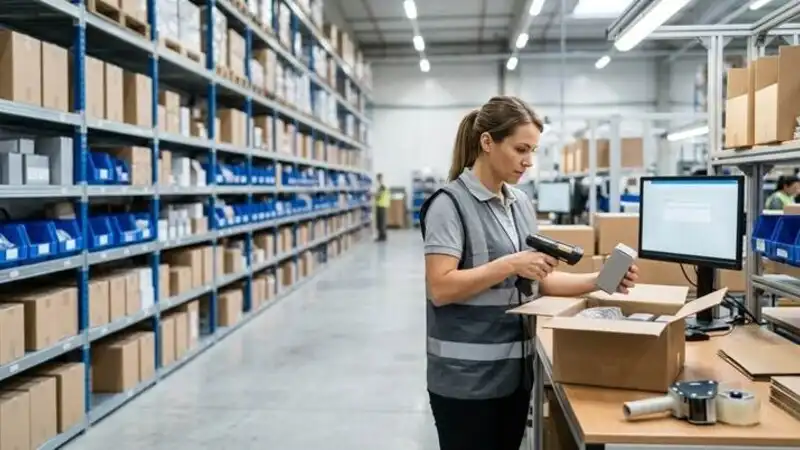
❝ Ask for a tour of the facility, either virtual or in person. Pay less attention to the sales pitch and more to the warehouse floor. Are the aisles clean and well-organized? Are employees using scanners for every transaction? Does the operational process seem logical or chaotic? The operational discipline you can see in a five-minute walk-through often tells you more than their marketing materials ever will.
Next, probe their inventory management beyond simple storage. In a climate like Las Vegas, with extreme summer heat, this is not a trivial detail. For products like supplements, cosmetics, or food items, a standard, non-air-conditioned warehouse can lead to spoiled inventory.
Ask these specific questions about inventory care:
- Do you offer climate-controlled or temperature-controlled storage? Be precise. “Climate-controlled” usually refers to managing humidity, while “temperature-controlled” means maintaining a specific temperature range. Know which one your product needs.
- What is your cycle counting procedure? Cycle counting is the process of continually auditing small subsets of inventory to ensure accuracy without shutting down operations. Ask how often they count, what their target accuracy is, and how they resolve discrepancies.
- What are your Service Level Agreements (SLAs) for receiving? How long after a shipment arrives at their dock will it be checked in and available for sale? A common standard is 24 to 48 hours. Anything longer can lead to stockouts.
Finally, ask how they handle labor, especially during peak season. A fulfillment center that relies heavily on untrained temporary staff is more prone to errors. Ask about their training program for new hires and their strategy for scaling up for holidays. A partner invested in a stable, well-trained workforce is also invested in the quality of their output.
Frequently asked questions
What are the biggest red flags when choosing a fulfillment partner? Look for opaque pricing, a lack of a client-facing software portal, and poor communication. If a potential partner cannot provide a clear rate sheet detailing every potential fee, you risk surprise charges later. Similarly, if you cannot get a demo of the dashboard you will use to see your inventory and orders, they may lack the technological transparency needed for a true partnership.
How much does the 3PL’s physical location impact my business? The location is a primary driver of your shipping costs and delivery speed. A warehouse’s location determines the shipping zones for your customers. A strategically located facility, for example, can reach a massive portion of the population within 1-2 days via ground shipping, which is far cheaper than air freight and meets modern customer expectations.
Can I use my own custom-branded packaging with a 3PL? Yes, in most cases you can. You are typically responsible for sourcing the custom boxes, mailers, or inserts and having them shipped to the fulfillment center. Be sure to ask if they charge extra fees for using non-standard packaging or for the labor involved in special projects like assembling kits or adding promotional materials.
What is the difference between a 3PL and a freight forwarder? A 3PL (Third-Party Logistics) provider manages your inventory and fulfills individual customer orders from their warehouse. A freight forwarder, on the other hand, acts as an agent to arrange the bulk transportation of your goods, for instance, moving a container from an overseas factory to your 3PL’s warehouse. You often use a freight forwarder to get products to your 3PL.
How are fulfillment costs typically structured? Most 3PLs break down their pricing into four main components. You will see charges for receiving inventory (per pallet or carton), storing it (per pallet or bin, per month), fulfilling orders (a fee per order plus a fee per item picked), and the actual cost of shipping passed on from the carrier.
Making the Right Choice is About Process, Not Price
Selecting a fulfillment partner is less about finding the cheapest quote and more about vetting an operational extension of your own business. The most critical information is not on the rate sheet. It is revealed by asking pointed questions about how they handle mistakes, manage exceptions, and provide you with visibility into their process. A low per-order fee is meaningless if it is accompanied by high error rates, lost inventory, or poor communication that damages your customer relationships.
Ultimately, your 3PL is the last company to touch your product before it reaches your customer. Their accuracy, speed, and professionalism directly reflect on your brand. The right partner provides more than just storage and shipping; they offer a stable, predictable, and transparent system that allows you to focus on growing your business. The best choice is the provider whose processes and technology give you the most confidence and control, because their performance becomes your reputation.
About the author
ShipOffers is a third-party logistics (3PL) and product sourcing company that has supported e-commerce businesses since 2001. The company provides direct-to-consumer fulfillment, custom product formulation, and private labeling services, primarily for brands in the health, wellness, and beauty sectors. With fulfillment centers in the United States and Europe, ShipOffers manages inventory, order processing, and global shipping for online retailers and performance marketers seeking to scale their physical product operations.