
By a vehicle repair industry contributor. The storm is over, and you see the damage. Your car’s roof and hood look like a golf ball, covered in dozens, sometimes hundreds, of small dents. First you feel frustrated. Then you have a bigger problem: how do you get this fixed the right way? The wrong choice can lead to a bad repair, a lower car value, and a permanent mark on your car’s history report.
Most hail damage today is fixed with a method called Paintless Dent Repair, or PDR. A technician uses special tools to gently push the metal back to its original shape from behind the panel. This saves the car’s factory paint. When done right, it’s like the damage never happened. The problem is that the quality of the repair depends completely on the technician’s skill. A quick search for hail dent repair near me will show many choices, but not all shops do the same quality of work.
Quick answer: The best way to fix most hail damage is Paintless Dent Repair (PDR). It doesn’t use fillers or new paint. But the quality of the repair comes down to the technician’s experience, not the tools they use. A bad PDR job can’t be undone, so checking out the shop is more important than just picking the method.
As you look at your choices, it helps to learn more about the process. This guide covers why repair quality matters, how to tell a good PDR shop from a bad one, and what decides whether a dent can be fixed. It ends with answers to common questions about cost, insurance, and repair time.
Why Does the Quality of a Dent Repair Matter So Much?
A good repair protects your car’s value and its original paint, while a bad one can permanently lower its value and cause problems later. When you look for hail dent repair nearby, choosing between a good PDR job and a normal body shop repair has a big impact on your money. A bad repair can leave you with paint that doesn’t match, visible filler, and a damage note on your car’s history report forever.
This is a big deal because hail damage costs a lot of money. According to the Insurance Information Institute, State Farm alone paid out over $5.6 billion in hail claims in 2025, up from about $5 billion in 2024, when more than $1.2 billion went to auto repairs. That is just one insurer. When many cars in one area get damaged, people rush to get them fixed. Not all repair shops have the same skills. Car owners need to be careful here, because a quick choice can lead to a bad, expensive repair.
This affects your car’s value over time. A good PDR job is a “no paint” repair. It doesn’t hurt your car’s history report or its sale price. But a normal repair with body filler and new paint can scare away future buyers. The quality of the repair and the use of factory (OEM) parts both affect a car’s value after it’s fixed. A bad PDR job that cracks the paint means you’ll need a normal repair, which will lower your car’s value for good.
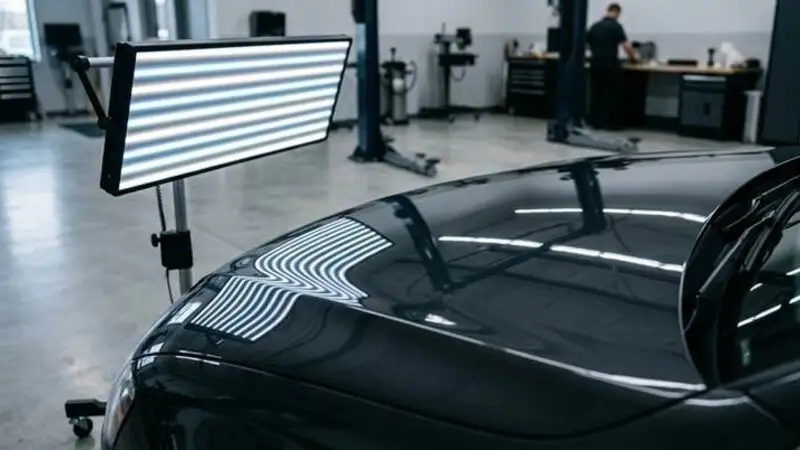
❝ The “light test” is the best way to judge quality. A skilled technician uses a special board with lines or a light to see every detail of the panel’s surface. Ask the shop to show you a finished repair under their light. If the reflection of the light’s straight lines is perfectly straight as you look across the repaired area, the job is excellent. If the lines bend or look wavy, the metal isn’t perfectly smooth.
It’s easy to see how a repair can go wrong. A technician without enough experience can stretch the metal too far, making a permanent high spot or bulge. They can also cause tiny cracks in the paint’s clear coat that you can’t even see. Over time, moisture gets into these cracks and makes the paint bubble and peel. The only way to fix that is to sand the whole panel down to the metal and repaint it, which costs a lot more.
How Do You Tell a Good PDR Shop from a Bad One?
You can spot a good shop by a few key things. They should specialize in PDR, be open about their process, offer a written lifetime warranty, and have proof of insurance. The most important part of PDR is the technician, not the tools. So, you should focus on their experience and the shop’s standards. A great technician can make dents disappear, but a bad one can make the damage permanent.
Before you agree to a repair, it’s smart to compare shops. A real, physical shop is a good sign of a solid business. Be careful of the temporary tents that pop up in parking lots after a big storm. These “hail chasers” might offer a low price, but they often don’t have the insurance, warranty, or responsibility of a local business. The National Insurance Crime Bureau often warns people about dishonest workers who show up after disasters. According to the NICB, some contractors who show up after hailstorms and other disasters take the payment without finishing the job, or do shoddy work with cheap materials. If a traveling crew has already left town, you have no way to get it fixed.
Here is a simple chart for comparing repair shops:
| Feature | High-Quality PDR Specialist | Low-Quality or Temporary Provider |
| Location | Permanent, physical shop address. | Temporary tent, mobile-only service. |
| Warranty | Lifetime written warranty on repairs. | Vague, verbal, or limited warranty. |
| Insurance | Can show proof of full insurance. | May not be properly insured. |
| Specialty | Focuses mainly on PDR, often hail. | General body shop; PDR is a sideline. |
| Estimate | Detailed, itemized, and written. | Vague, high-pressure, “today only” price. |
| Proof | Lets you inspect finished work under detail lights. | Avoids showing finished work closely. |
❝ Ask any potential shop two direct questions: “How many years of PDR experience does the technician working on my car have?” and “Can I see your certificate for garage keepers insurance?” The first question focuses on the person’s skill, not just how long the shop has been open. The second proves your car is protected from fire, theft, or damage while they have it, which is different from regular business insurance.
Finally, trust your instincts. A good shop will take time to explain the repair, show you their work, and give you a clear, written estimate without pressure. They should help you with the insurance claim and tell you exactly what they will do to your car. If a shop avoids your questions, pushes you to sign a contract right away, or offers a deal that seems too good to be true, it’s best to leave.
What Actually Determines if a Dent Can Be Fixed?
Whether a dent can be fixed depends more on its depth and location than its size. A large, shallow dent on a flat hood is often an easy fix. But a small, sharp dent on a curved body line can be very hard, or even impossible, to fix with PDR. The main thing is whether the metal has been stretched too far.
A good PDR tech uses the metal’s “memory.” This means the metal wants to go back to its original shape. The tech makes a series of careful, controlled pushes from behind the panel to guide the metal back into place. Getting to the back of the panel is the first challenge. For a roof, a tech has to remove the ceiling material inside the car (the headliner). For a side panel, they might go through the taillight opening. If a dent is over a strong support beam where tools can’t reach, PDR might not work.
The type of metal is also very important. Most car panels are made of steel, which is easy to work with. But newer cars often use high-strength steel (HSS) and aluminum to be lighter. These metals act differently. High-strength steel is stiffer and needs more force to move. Aluminum is softer and doesn’t hold its shape as well.
❝ Aluminum panels, found on many newer trucks and luxury cars, are a real test of a technician’s skill. The metal is harder to work with and can easily stretch if pushed too hard. A tech who usually works on steel can damage an aluminum panel, creating a permanent bulge. It takes a lighter touch, more patience, and special tools to fix it correctly.
The biggest limit for PDR is stretched metal. A very sharp hit, like from a big piece of hail, can stretch the metal so it can’t go back to its old shape. It’s like a rubber band that’s been pulled too far and won’t snap back. If a tech tries to fix stretched metal, they will only make it worse by creating a high spot. Then, the only choice left is a normal body shop repair with sanding, filler, and new paint.
Frequently Asked Questions About Hail Repair
How much does it cost to fix dents from hail? There is no flat price for hail repair. Technicians use a detailed pricing chart that looks at three things: the number of dents on each panel, the size of those dents (from dime-sized to half-dollar-sized and bigger), and what the panel is made of. Aluminum panels are harder to work with than steel and cost more. A written estimate is the only way to get a real price, and the repair is usually covered by your comprehensive auto insurance.
Can hail dents simply be popped out? “Popping out” dents is a common myth. Real PDR is a slow, careful process of working the metal from behind with special tools, not pulling it from the front with suction cups. DIY kits often fail because they can’t release the stress in the metal. Worse, they can crack the paint or stretch the panel, so a proper paintless repair is no longer possible.
Is it worth getting hail damage repaired? Yes, for two big reasons. First, unrepaired hail damage lowers your car’s resale value. Second, if you take an insurance payout and don’t fix the car, your insurer will likely note the unrepaired damage on your policy. That means they won’t pay again for those same panels, whether from another hailstorm or a different accident, until you can prove the first damage was fixed.
Will my insurance rates go up if I file a hail claim? In most cases, no. Hail damage falls under the comprehensive part of your auto insurance, not collision. Weather claims are usually treated as “no-fault” events. Many claims in a short time could affect your policy, but a single hail claim is very unlikely to raise your rate.
How long does a typical PDR hail repair take? It depends on how bad the damage is. A car with light damage might take one to three days. A car with heavy damage could need a week or more, especially if the headliner has to come out to reach the roof. The longest delays are often paperwork, like waiting for the insurance adjuster’s final approval, not the repair itself.
The Bottom Line: A Craft, Not a Commodity
After a hailstorm, the most important choice you make is not about the insurance claim. It is about whose hands will touch your car. The goal is not just to make dents go away. It is to save the original factory finish, a tough coating that a body shop can never perfectly copy. A good repair is one you can’t see at all.
That result is not luck. It comes from picking a skilled technician over the cheapest or most convenient option. Ask about the technician’s PDR experience, ask to see finished work under a detail light, and check that the shop has a permanent location and proper insurance. These steps separate a lasting repair from a quick fix that can lead to cracked paint and bigger problems later.
In the end, Paintless Dent Repair is a craft. The right choice protects your car’s value. The wrong one can turn a fixable problem into a permanent flaw.
About the author
This article is contributed by the team at Mile High Dents, a Denver-based shop specializing in Paintless Dent Repair (PDR). Established in the late 1980s, the company focuses almost only on hail damage, which makes up over 99% of its work. Its technicians, many with over 15 years of PDR experience, help car owners across the Denver metro area with insurance claims and repairs while saving the car’s original factory finish.