
By a welding industry contributor. Choosing a new MIG welder is a big investment. This choice is about more than just money; it directly affects what you can do. The wrong machine can slow you down, limit the kinds of jobs you can take, and make projects take longer. For a professional, this lost time means lost money. The U.S. Bureau of Labor Statistics reports that welders earn a median pay of $53,750 a year. This shows that the right gear is a direct investment in your career.
One particular machine has long been a favorite because of its mix of power, portability, and ease of use. It has earned a solid reputation in auto body shops, on farms, and in small fabrication businesses for good reasons. This means when you look for a miller 211 for sale, you’re looking at a machine that has proven itself. But does a strong history mean it is still the best choice for you today?
❝ When checking out a machine, look beyond the specs. Ask to see the wire drive system. A strong, all-metal drive system feeds wire more smoothly than one with plastic parts. Over time, plastic parts can lead to an unsteady arc, which is very frustrating for any welder.
Quick answer: The Miller 211 is still a top choice for portable welders that can handle different jobs. It is especially known for its ability to use two voltages and its easy-to-use controls. Whether it is a good value for you depends on your specific needs. You must check its arc quality and duty cycle based on the metals and thicknesses you weld most often. It is great for light to medium-sized jobs, but it has limits you need to know about before you buy.
What’s inside
- What Makes This Welder So Popular?
- How Do You Judge Its Core Features Beyond the Spec Sheet?
- What Are the Real-World Material Limits?
- What Questions Should You Ask a Seller?
- Frequently Asked Questions
- Conclusion: Making the Final Call
What Makes This Welder So Popular?
Its popularity comes from a design that solves key problems for welders. It is portable, can be plugged into common power outlets, and allows for a quick setup on smaller jobs. These are not just nice extras. They are features that help a welder work better and earn more money. In a trade where time is money, getting set up quickly is a big plus.
Its biggest feature is that it can use two voltages. The ability to run on both standard 120V household power and 240V shop power gives you a lot of flexibility. This is a key advantage for mobile repairs or work at job sites where high-power outlets are not available. This flexibility lets you take jobs outside your shop without a big, heavy generator. This ability opens up more places to work and more customers.
Its inverter technology is the reason for these benefits. Older machines used heavy copper-wound transformers. An inverter uses advanced electronics to control the welding arc. This makes the machine much lighter, often under 40 pounds, so it is truly portable. More importantly, this technology gives you a smoother, more stable arc that is easier to control. For a professional, better arc control means less spatter, cleaner welds, and less time spent grinding and cleaning up. The U.S. Bureau of Labor Statistics reports a median wage of $25.84 per hour. Every minute you save on finishing work helps you make more money.
❝ A machine’s duty cycle, which is how long it can weld in a 10-minute period before it needs to cool down, is rated at a certain air temperature. In a cooler place, it might run a little longer than its rating. But in a hot place or an area without good airflow, your real duty cycle will be lower than what the maker lists.
Finally, the easy-to-use control panel has an “Auto-Set” feature. This makes it easier for new welders to learn. The system suggests starting settings based on the wire and material thickness you choose. Experienced welders will still adjust these settings by hand for certain jobs, but it gives a great starting point that speeds up the setup process. The U.S. Bureau of Labor Statistics projects job growth for welders to be 2% from 2025 to 2035. This slow growth means being able to make quality welds quickly is key to staying competitive.
How Do You Judge Its Core Features Beyond the Spec Sheet?
You should judge a welder by its arc quality, how long its parts will last, and if its duty cycle fits your daily work. These three things show the machine’s long-term value better than the max amps printed on the case. A spec sheet tells you what a machine can do, but these details show how well it will work for you.
First, think about the arc quality, which mainly comes from its inverter design. Inverter machines have a much smoother and more stable arc than older, heavier transformer models. This stability makes it easier to lay a steady weld bead, especially on thin materials like car body panels. It also creates less spatter, which saves you valuable cleanup time. While inverters have more complex electronics, they perform better and use less energy. These are big advantages for most fabrication jobs.
| Feature | Inverter-Based (like the 211) | Traditional Transformer |
| Weight | Lightweight, highly portable | Very heavy, typically on a cart |
| Arc Quality | Smooth, stable, easier to control | Can be harsher, requires more skill |
| Power Consumption | More efficient, lower electrical draw | Less efficient, higher electrical draw |
| Electronics | Complex, sensitive to dust and moisture | Simple, highly durable and long-lasting |
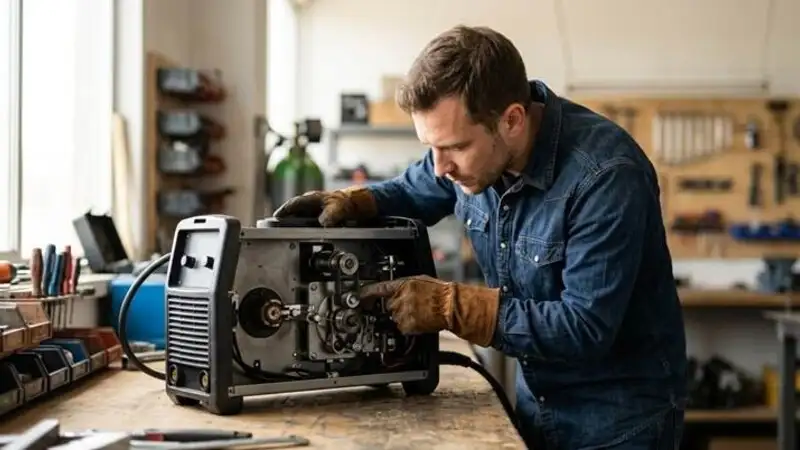
Next, check the wire drive system yourself. This is a key mechanical part that often fails. Ask the seller to open the side panel so you can inspect it. A robust, cast-aluminum drive assembly will outlast a plastic one. It provides more consistent wire feeding, which prevents frustrating problems like wire tangles or an unstable arc.
Finally, consider the duty cycle in practical terms. The 211 is rated at 40% at 150 amps on 240V power. This means in a 10-minute period, you can weld for four minutes before the machine needs to cool for six. For short welds on an auto body panel, this is more than enough. But if you are welding a long seam on a 1/4 inch steel plate, you may hit that limit. You must match the duty cycle to the length of the welds you perform most often.
What Are the Real-World Material Limits?
A welder’s true value is shown by how it handles different materials in real situations. The Millermatic 211 is designed for light to medium-duty fabrication. It performs very well within its intended range.
For auto body work, this machine is an excellent tool. When welding thin 22 or 24-gauge sheet metal, the stable inverter arc is a major benefit. It gives you precise control to prevent burning through the delicate panels. Using a 0.023-inch solid wire and C25 shielding gas, you can produce clean, small welds that require minimal grinding.
Consider a common repair, like replacing a rusted rocker panel on a classic car. The 211’s smooth arc allows you to make a series of quick tack welds without overheating the panel. This control helps you avoid warping the metal, which is a common and costly mistake.
For thicker materials, like building a utility trailer from 3/16 inch steel tubing, the machine also performs well. On 240V power, you will have plenty of amperage to get good penetration. It can handle these projects all day long. The machine is rated for up to 3/8 inch mild steel in a single pass. While possible, this is the absolute upper limit. For frequent work on metal this thick, a larger, 250-amp class machine would be a better choice for long-term reliability.
❝ Insider Tip: When welding thin steel, listen to the arc. A sharp, crackling sound like frying bacon is a good sign of proper settings. A loud, hissing sound often means your voltage is too high, risking burn-through.
The machine can also weld aluminum with the addition of an optional spool gun. It can handle aluminum from 18 gauge up to 3/8 inch. This is great for occasional repairs, like fixing a crack in an aluminum boat or small fabrication projects. However, for a shop that specializes in aluminum, a dedicated AC TIG welder or a more advanced MIG machine with pulse capabilities would provide better results.
What Questions Should You Ask a Seller?
Before you make a purchase, asking the right questions can save you time and money. Go beyond the price and technical specs. Focus on the total cost of ownership and support.
First, ask exactly what comes in the box. Does it include a gas regulator, a sample spool of wire, and extra contact tips? Knowing what is included helps you budget for any immediate accessories you will need to buy. A “complete” package from one seller might be different from another.
Next, you should ask about the warranty and service process. Find out the length of the warranty on different parts, like the power source and the MIG gun. More importantly, ask where you would take it for service. A local repair center is much more convenient than having to ship a heavy machine across the country.
You can also ask for a demonstration of the Auto-Set feature. Seeing it in action can help you decide if it fits your skill level and preferences. This is especially helpful if you are a new welder. It lets you see how quickly you can get set up and start welding.
Finally, ask about common replacement parts. Inquire about the cost and availability of contact tips, nozzles, and gun liners. These are the parts you will replace most often. Easy access to affordable consumables is important for keeping your welder running without long downtimes.
Frequently Asked Questions
How thick of metal will a Millermatic 211 weld? On 120V household power, the machine can weld mild steel from 24 gauge up to 3/16 inch thick. When you connect it to 240V power, its capability increases significantly. It can handle mild steel from 24 gauge up to 3/8 inch in a single pass. For aluminum, it can weld from 18 gauge to 3/8 inch, but this requires the optional spool gun.
Is the Millermatic 211 a good welder for a beginner? Yes, it is an excellent choice for beginners and hobbyists. Its “Auto-Set” feature is a major advantage. It automatically selects the correct voltage and wire speed based on your material thickness and wire diameter. This removes much of the guesswork and helps new users produce quality welds much faster. The smooth, stable arc is also more forgiving than on older machines, making it easier to learn proper technique.
Conclusion: Making the Final Call
The Millermatic 211 earned its reputation for a reason. It combines portability, power flexibility, and user-friendly controls in one package. For a small fabrication shop, mobile repair service, or serious hobbyist, it remains a very strong contender. Its ability to run on common household power opens up a wide range of job opportunities.
However, it is not the perfect machine for every single task. If your work consists mainly of welding steel thicker than 1/4 inch all day, a larger machine with a higher duty cycle would be a better investment. Similarly, if you plan to specialize in aluminum fabrication, a dedicated machine with more advanced features would serve you better. Your final decision should be based on a clear understanding of the work you do most.
About the author
This article was written by a contributor from Welding Supplies from IOC. Welding Supplies from IOC is a supplier of welding equipment, consumables, and safety products.