
That first big summer heatwave arrives, and so does the electric bill that follows. If you’ve ever been shocked by that number, you’re not alone. Air conditioning uses more energy than almost anything else in a home. In fact, according to the U.S. Energy Information Administration, air conditioning made up about 12% of total U.S. home energy spending in 2015. A lot of that cost isn’t from using your AC, but from wasting energy when it has to fight itself to do its job.
A system with dirty coils, low cooling fluid (refrigerant), or a weak fan motor has to run longer and harder to make the same amount of cool air. This extra work doesn’t just make your utility bills bigger; it also wears out the most expensive parts faster. Small, ongoing problems are what lead to major breakdowns in the middle of July. Knowing what a full ac service centennial can prevent helps you manage your budget and stay comfortable. It’s less about a simple checkup and more about a deep check-up of the entire system’s health.
Quick answer: A proper AC service is a full check-up and tune-up, not just changing a filter. A technician should test electrical parts, clean important parts like coils, check refrigerant levels, and make sure air is flowing correctly. This process helps the system run better, lowers energy costs, and catches small issues before they become costly breakdowns.
What’s inside
- Why Annual AC Service is More Than Just a Suggestion
- How Can You Tell if a Service Quote is Fair?
- How Does Colorado’s Climate Affect Your AC’s Health?
- Frequently Asked Questions About AC Maintenance
- The Real Goal of Annual AC Maintenance
Why Annual AC Service is More Than Just a Suggestion
It is a direct way to lower your energy bills and prevent the most expensive system failures. An AC that isn’t taken care of doesn’t just work poorly; it starts wasting energy. It has to work harder and harder to make less and less cool air. This drives up costs until an important part breaks.
The amount of energy used for cooling is huge. In 2020 alone, U.S. homes used 254 billion kilowatt-hours of electricity for air conditioning, according to the U.S. Energy Information Administration. A lot of that energy is wasted by systems that are not running as well as they should. The main cause is often simple dirt. A layer of dust on your coils acts like a blanket, keeping the system from pulling heat out of your home and releasing it outside. This forces the compressor, the heart of the system, to run longer and use more power to cool your house.
This inefficiency is a big deal. It creates a chain reaction that puts stress on the whole system. The U.S. Energy Information Administration notes that in commercial buildings, cooling and ventilation used 32% of all electricity in 2018. While homes are different, the idea is the same: forcing air through clogged filters and over dirty coils puts a lot of stress on the fan motor. At the same time, an overworked compressor gets too hot, which can damage electrical parts like capacitors and relays.
❝ Even a modest refrigerant shortfall can noticeably increase an air conditioner’s electricity use. This is because the wrong amount of refrigerant makes it much harder for the system to move heat, forcing it to run constantly and inefficiently.
In the end, this built-up stress is what leads to sudden breakdowns in the middle of summer. The fan motor burns out, the capacitor fails, or the compressor locks up. These are not random problems. They are what you’d expect to happen when a system works too hard for too long. Ask a technician to show you the “temperature split”, the difference in temperature between the air going into and coming out of the indoor unit, before and after a cleaning. A big improvement is a clear sign of better performance and future energy savings.
How Can You Tell if a Service Quote is Fair?
A fair quote should match the time and skill needed for a complete check-up, not just a quick look. The price should come with a detailed list of tasks that test, measure, clean, and check your system’s health, going far beyond just changing a filter.
The key difference is in the list of tasks. A cheap “tune-up” special might just be a technician rinsing the outdoor unit and checking the thermostat. A full service, however, is a process that uses real measurements. The technician should use special tools like a multimeter to check electrical parts and gauges to measure refrigerant pressures. This level of detail is needed to make sure the system is running the way the maker designed it to run. A checklist like the one from the federal ENERGY STAR program is a good guide for what a full service should include.
To see the difference clearly, compare the tasks included in a quote.
| Minimal “Check-Up” | Full Diagnostic Service |
| Change customer-provided filter | Check and clean or replace filter |
| Visually inspect unit | Clean indoor and outdoor coils |
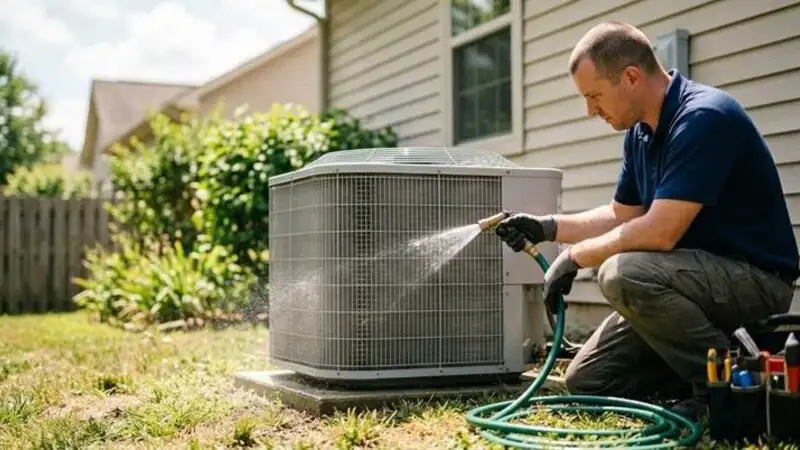
| Rinse outdoor unit with a hose | Flush and clean drain line |
| Check thermostat operation | Measure refrigerant levels to make sure they’re right |
| Test key electrical parts (capacitors, relays) | |
| Check how much power the motors are using | |
| Inspect and tighten electrical connections | |
| Check for air leaks in ducts near the unit |
❝ A big red flag is a quote for adding refrigerant without also offering to find and fix a leak. Simply “topping off” a system is like filling a leaky tire with air. It doesn’t solve the real problem and can lead to more service calls and, eventually, a failed compressor.
When looking at a quote, ask the company specific questions about what they do. Will they measure refrigerant levels to make sure they are correct? Will they test the run capacitors? Do they clean both the indoor and outdoor coils? The answers will tell you if you are paying for a real check-up or just a quick look. A fair quote will be backed by a clear, detailed list of work that aims to make your system run better and prevent future breakdowns.
How Does Colorado’s Climate Affect Your AC’s Health?
It makes your system work harder than it would at sea level. The mix of high altitude and dry, dusty air creates special challenges that affect your AC’s performance and how long it lasts. Understanding these local issues is key to taking care of it properly.
First, the altitude matters. Air is thinner at a mile high. This means that for every bit of air your system’s fan moves over the coils, there is less air to absorb or release heat. The process of moving heat becomes less effective. As a result, your AC unit has to run longer to cool your home than it would in a city at a lower elevation. This not only uses more energy but also adds wear and tear over time on the compressor and fan motors.
Second, the dry climate adds a different kind of stress. Low humidity means the system doesn’t have to work as hard to remove moisture from the air (which uses a lot of energy in humid places). But it also means more fine dust, pollen, and cottonwood seeds are in the air. These particles get pulled into the outdoor unit, where they can form a thick blanket on the coils that traps heat. This buildup makes it hard for the system to get rid of heat outside, forcing the compressor to work under much higher pressure and heat, which is a top cause of it breaking down too soon.
❝ When talking about a new system, ask the contractor how they adjust for altitude. Manufacturers provide specific information for high-elevation areas. A system that is the right size for the Front Range might be different from one at sea level to make up for the thinner air and ensure it can handle the cooling needs without constant strain.
The bottom line is that while Colorado’s “dry heat” might feel more comfortable, it presents a special problem for AC units. The lower performance from the altitude and the higher risk of clogged coils from dust make a full annual cleaning and electrical check very important. A system that is both clean and running with the correct electrical and refrigerant levels is the only way to ensure it will keep you cool through the hot summer.
Frequently Asked Questions About AC Maintenance
How much should a standard AC service call cost? The cost can change based on how much work is done. A basic check-up might be cheaper, while a full check-up that includes deep cleaning of coils and detailed electrical testing will cost more. The final price can also change if the technician finds a part that needs to be replaced right away, like a failing capacitor. That would be an extra charge for the part and the work to install it.
How often does my air conditioner really need to be serviced? For most homes, an annual service is what manufacturers and energy experts recommend. Following this schedule is often required to keep your manufacturer’s warranty active. Because of Colorado’s dusty environment, an annual cleaning is especially important to keep air flowing well and prevent stress on the system’s parts.
What is the “$5,000 Rule” for AC repair vs. replacement? This is a common guideline to help you decide if a big repair is worth the cost. You multiply the repair cost by the age of your AC unit in years. If the number is more than $5,000, replacing the unit is often the smarter money choice for the long run. For example, a 1,200 x 10 = $12,000) would strongly suggest it’s time to buy a new, more efficient system.
What’s the difference between an AC service and a repair? A service is maintenance done ahead of time to prevent problems, help the unit run better, and make it last longer. A repair is a visit to fix something that has already broken, like a fan that won’t spin or a unit that blows warm air. Regular service calls are meant to reduce the need for surprise (and often more expensive) repair calls.
Are there any maintenance tasks I can do myself? Absolutely. You can and should do a few key things. Changing your indoor air filter every 30 to 90 days is the most important one. You can also keep the area around your outdoor unit clear of leaves, grass clippings, and other junk to help air flow freely. However, any work that involves electrical parts or handling refrigerant should always be left to a trained expert because of safety risks and the need for special tools.
The Real Goal of Annual AC Maintenance
The true purpose of an annual service call is not just to clean your air conditioner, but to check on its health. A quick check might find obvious problems, but it leaves you guessing about the system’s real condition. A full check-up, on the other hand, measures how it’s working instead of just guessing. It confirms that the system is running as the manufacturer intended, which is the only real sign of how well and how reliably it’s working.
This change in thinking is important. Instead of seeing maintenance as just another cost, see it as a way to prevent a much bigger, more frustrating breakdown. The most valuable part of the service is the information you get. A technician who measures refrigerant levels, tests electrical parts, and checks airflow is giving you a clear picture of your system’s health. This data-driven approach allows for small fixes that prevent major failures during the hottest part of the summer.
In the end, your decision should be based on the list of work being offered. A detailed checklist that includes both cleaning and electrical testing is the sign of a professional service that is meant to make your system work better, not just check a box. The goal is to make sure your system can handle a hot summer efficiently and reliably, giving you peace of mind that it will work when you need it most.
About the author
This article is from the team at Steel T Home Services, a second-generation, family-owned company that has provided HVAC, plumbing, and electrical services to the Denver Metro region since 1979. With decades of experience, their technicians focus on maintenance and repair based on careful testing for home systems. As a Carrier Factory Authorized Dealer, their work is based on careful, accurate work and on teaching homeowners about their systems.